Claiming Your Weekend: Why Your Outdoor Pursuits Demand a Mid-Week Mobility Strategy
You cannot leave a high-performance vehicle parked in the garage all week and expect it to handle tight corners flawlessly on Saturday morning. The same logic applies to your body. Discover how a simple, consistent mid-week mobility routine can transform your joint comfort, elevate your energy, and keep your weekend adventures going strong for years to come.
Friday afternoon arrives, and the anticipation builds. The hiking boots are brushed off, the mountain bike tires are inflated, or the golf clubs are loaded into the trunk. For many of us in our late forties and fifties, the weekend is our time to reclaim our vitality. It is the window where we trade the glow of the computer monitor for the morning sun filtering through the trees. We push our limits, breathe the fresh air, and remember what it feels like to be fully alive and in motion.
But there is a familiar rhythm that often follows. Sunday evening rolls around, and a creeping stiffness settles into the lower back. Monday morning brings a sense of rigidity in the knees and hips, making the descent down the staircase feel more like a chore than a simple daily task. We brush it off as a natural part of getting older, a small toll to pay for a weekend well-lived.
However, the true source of that Monday morning stiffness is rarely the Saturday morning hike itself. More often than not, the culprit is the preceding five days. The contrast between a highly sedentary workweek and a sudden burst of intense weekend activity creates a demanding environment for your joints, muscles, and connective tissues. To truly enjoy your weekend pursuits without the lingering rigidity, you need a bridge. You need a mid-week mobility strategy.
The Desk-to-Trail Paradox
Consider the posture most of us adopt from Monday through Friday. We sit in cars or on trains during our commutes. We sit at desks, our shoulders subtly rounding forward to reach our keyboards, our necks craning slightly toward our screens. In this seated position, the hip flexors remain in a shortened, contracted state for hours on end. The glutes—the powerful engines responsible for driving us up a steep trail or powering a golf swing—essentially go dormant.
When Saturday arrives and we suddenly ask our bodies to perform dynamic, multi-directional movements, we are demanding peak output from a chassis that has spent the last hundred hours locked in a static, folded position. Connective tissues thrive on regular, varied movement to remain pliable and well-lubricated. When we deny them that movement during the week, they adapt to the shape of our office chairs.
This desk-to-trail paradox is what makes the first mile of a weekend run feel so heavy, or the first few swings on the fairway feel tight and uncoordinated. By introducing a mid-week mobility practice, you are actively reminding your body of its full range of motion. You are keeping the hinges oiled, ensuring that when the weekend arrives, your body is already prepared to respond.

Mobility vs. Flexibility: Understanding the Difference
Before diving into a routine, it is helpful to distinguish between flexibility and mobility. These terms are often used interchangeably, but they represent different physical capabilities, especially as we navigate midlife.
Flexibility is the passive ability of a muscle to lengthen. It is about how far you can stretch when gravity or an external force is assisting you. Mobility, on the other hand, is active. It is your ability to actively control your joints through their full, intended range of motion.
"Mobility is not just about reaching your toes; it is about having the strength, stability, and control to move fluidly through life's varied terrains."
For the weekend warrior, mobility is the far more valuable asset. You do not necessarily need the flexibility to perform a split, but you absolutely need the mobility to step over a fallen log on a hiking trail, rotate your torso smoothly while paddling a kayak, or crouch down to read a putting green without your knees voicing their displeasure. A solid mid-week strategy focuses on this active, controlled movement.
The Mid-Week Protocol: Three Pillars of Joint Comfort
The beauty of a mid-week mobility strategy is that it does not require a gym membership, specialized equipment, or an hour of your time. Consistency is far more powerful than intensity. Devoting just ten to fifteen minutes a day, perhaps in the morning before the house wakes up or in the evening while unwinding, can yield profound shifts in how your body feels.
Focus your efforts on the three areas that suffer the most from the modern workweek: the hips, the thoracic spine, and the ankles.
1. Unlocking the Hips
Because sitting keeps the front of the hips chronically short and tight, opening them up is priority number one. Incorporate movements that gently extend the hip joint. A simple kneeling lunge—where you rest one knee on a soft pad and step the other foot forward, gently shifting your weight to open the front of the kneeling leg—can do wonders. The goal is not to push to the point of discomfort, but to breathe into the stretch, allowing the tissues to relax and lengthen. Pair this with gentle side-to-side lateral movements to awaken the muscles that stabilize your pelvis during uneven hikes or lateral sports.
2. Mobilizing the Thoracic Spine
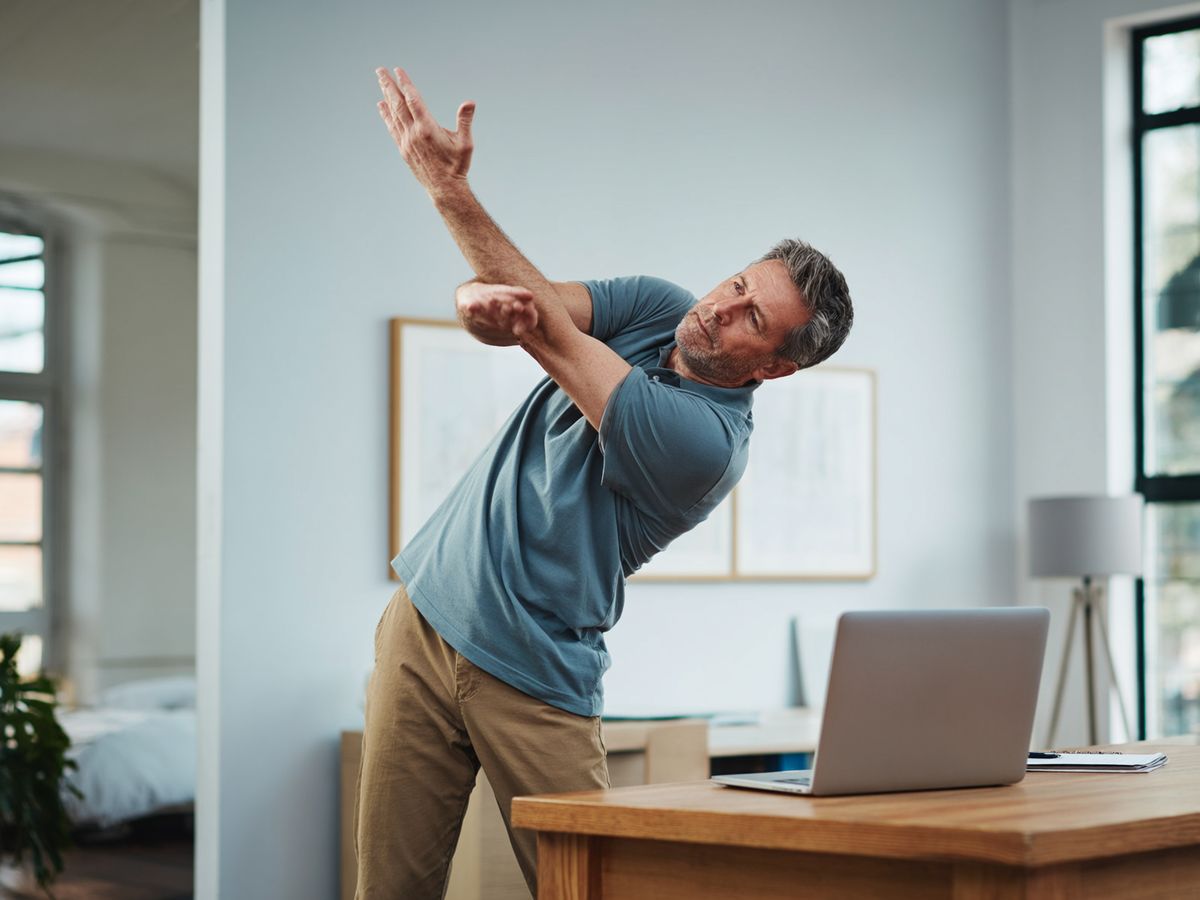
The mid-back, or thoracic spine, is designed for rotation and extension. However, keyboard work encourages a rounded, forward-leaning posture that locks this area down. When the mid-back loses its mobility, the lower back and the shoulders are forced to overcompensate, leading to that familiar stiffness after a weekend of activity. To counteract this, practice gentle rotational movements. While on your hands and knees, try threading one arm under the other, gently lowering your shoulder toward the floor to encourage a twist in the mid-back. Follow this by opening the chest, reaching that same arm up toward the ceiling. Restoring this rotation is like removing a restrictor plate from your engine—suddenly, breathing is easier, and your posture feels naturally upright.
3. Awakening the Ankles and Calves
Your feet and ankles are your first point of contact with the earth. They are your primary shock absorbers. Stiff ankles force the knees and hips to absorb the impact of every step on a rocky trail. Spend a few minutes each day simply rotating your ankles in deep, slow circles. Practice standing on the balls of your feet and slowly lowering your heels to stretch the calves. Maintaining supple ankles ensures that your body can efficiently manage the varied terrain of your weekend adventures.
Integrating "Movement Snacks" into Your Day
While a dedicated ten-minute routine is excellent, you can compound its benefits by changing how you navigate your workday. Think of these as "movement snacks"—bite-sized portions of activity that break up long periods of stagnation.
- The 45-Minute Rule: Set a subtle timer on your computer or watch. Every 45 minutes, stand up. You do not need to do a full workout; simply standing, reaching your arms overhead, and taking three deep breaths resets your posture and encourages circulation.
- Active Meetings: If you have a phone call that does not require you to look at a screen, take it while walking. Pacing the room or walking around the block keeps the joints moving and often sparks better creative thinking.
- Floor Time: In the evening, try sitting on the floor while watching television or reading, rather than sinking into a soft couch. Sitting on the floor naturally encourages you to shift positions frequently—cross-legged, legs extended, kneeling—which passively promotes hip and knee mobility.
- The Doorway Stretch: Every time you walk through a specific doorway in your home, place your forearms on the doorframe and gently lean forward for ten seconds. This is a remarkably effective way to open up a tight chest and counteract the keyboard slump.
Fueling Your Active Lifestyle
Adopting a mid-week mobility strategy is a commitment to your future self. It is an acknowledgment that the adventures do not have to stop, or even slow down, just because we are advancing through midlife. By dedicating a few moments each day to active, mindful movement, you bridge the gap between the sedentary workweek and the dynamic weekend. You teach your body to remain resilient, supple, and ready for whatever the trail, the course, or the water throws your way.
Of course, keeping your chassis lubricated and your energy levels high requires more than just movement; it requires consistent, high-quality nutritional habits. Supplying your body with the right building blocks ensures that your joints have the daily support they need to recover from the workweek and thrive during your weekend pursuits. If you are looking for a simple, effective way to complement your new mid-week mobility routine and support lasting joint comfort from the inside out, discover how the right daily nutritional approach can help you stay active, energized, and ready for the weekend.