Redefining the Home Office: Subtle Adjustments to Sustain Your Posture During Long Sprints
The days of powering through an eight-hour stretch folded over a laptop on the dining room table are catching up with us. Here is how to rethink your workspace to support everyday mobility, maintain your energy, and keep your body comfortable—even when the deadlines pile up and the hours slip away.
When the home office first became a staple of our daily routines, many of us made do with whatever flat surface was available. A kitchen island, a spare bedroom desk, or even the living room sofa served as a makeshift command center. But as we navigate our peak career years, the way we work has evolved, and our physical environment needs to evolve with it. The temporary setups that once felt novel can gradually drain our vitality, leaving us feeling stiff and depleted by the time we log off.
Deep focus is a requirement for the kind of high-level work we do, but when we settle into a heavy concentration sprint, our bodies often pay the toll. We lean closer to the screen, our shoulders creep up toward our ears, and our breathing becomes shallow. Over time, these unconscious habits influence our overall mobility and joint comfort. The goal is no longer just getting the work done; it is getting the work done while preserving our physical energy so we can actually enjoy our evenings and weekends.
Redefining your workspace does not require a complete architectural overhaul or a budget-busting renovation. Instead, it is about making subtle, intentional adjustments to your environment. By aligning your desk, your chair, and your daily habits with your body's natural mechanics, you can transform your home office from a place of physical compromise into a foundation for sustained endurance.
The Myth of the Rigid Spine
For decades, workplace ergonomics focused on achieving a single, "perfect" posture: sitting bolt upright, feet flat, eyes straight ahead, locked in a ninety-degree grid. While the geometry of that setup is sound in theory, it ignores a fundamental truth about the human body. We are not designed to remain static for hours on end, no matter how perfectly aligned we might be.
The most supportive posture is simply your next posture. Remaining fluid and shifting your weight throughout the day does more for your joint comfort than any rigid alignment ever could.
Holding any position for too long requires continuous muscular effort, which eventually leads to fatigue. The secret to maintaining joint comfort and keeping your energy levels steady is dynamic movement. Your workspace should encourage you to shift, adjust, and rebalance naturally as you work. Think of your posture not as a statue you have to pose for, but as a fluid, ongoing adjustment.
Rebuilding Your Base: Chair and Desk Mechanics
Your chair is the foundation of your workday. If your foundation is off, every other part of your body has to work overtime to compensate. Start by adjusting the height of your seat. When you sit back, your feet should rest entirely flat on the floor. If they dangle or if you find yourself resting them on the legs of your chair, you are subtly throwing your pelvis out of its natural alignment.
Pay close attention to the angle of your knees. They should rest just slightly below your hips. This subtle downward slope opens up your hip angle, allowing your pelvis to tilt forward naturally. When your pelvis is positioned correctly, the natural curve of your lower spine is supported without requiring you to forcefully hold your chest out.
Once your chair is dialed in, bring your desk into the equation. The height of your work surface dictates the tension in your shoulders and neck. Rest your hands on your keyboard. Your elbows should hover right around a ninety-degree angle, and your forearms should be roughly parallel to the floor. If you have to hike your shoulders up to type, your desk is too high. If you find yourself slouching forward to reach the keys, it is too low. A desk that meets you exactly where you are allows your shoulder muscles to finally clock out and relax.
Elevating Your Gaze
Perhaps the most common culprit behind a mid-afternoon energy slump is the placement of the monitor. Laptops are incredible tools for portability, but they are ergonomically challenging for long-term use. Because the screen and the keyboard are attached, you are forced to choose between proper arm height and proper eye level. Usually, the eyes lose, and we end up looking down.
When you look down, even by a few degrees, the weight of your head pulls forward. Your neck and upper back have to work continuously like a crane holding a heavy load. This constant tension drains your energy reserves long before your workday is over.
To fix this, separate your screen from your keyboard. Elevate your monitor—or put your laptop on a stand and use an external keyboard—so that the top third of the screen aligns perfectly with your natural eye level when you are sitting tall. You should be able to scan your emails and read documents simply by moving your eyes, not by tilting your head. This simple elevation cue naturally encourages you to sit back into your chair, opening up your chest and allowing for deeper, more restorative breathing.
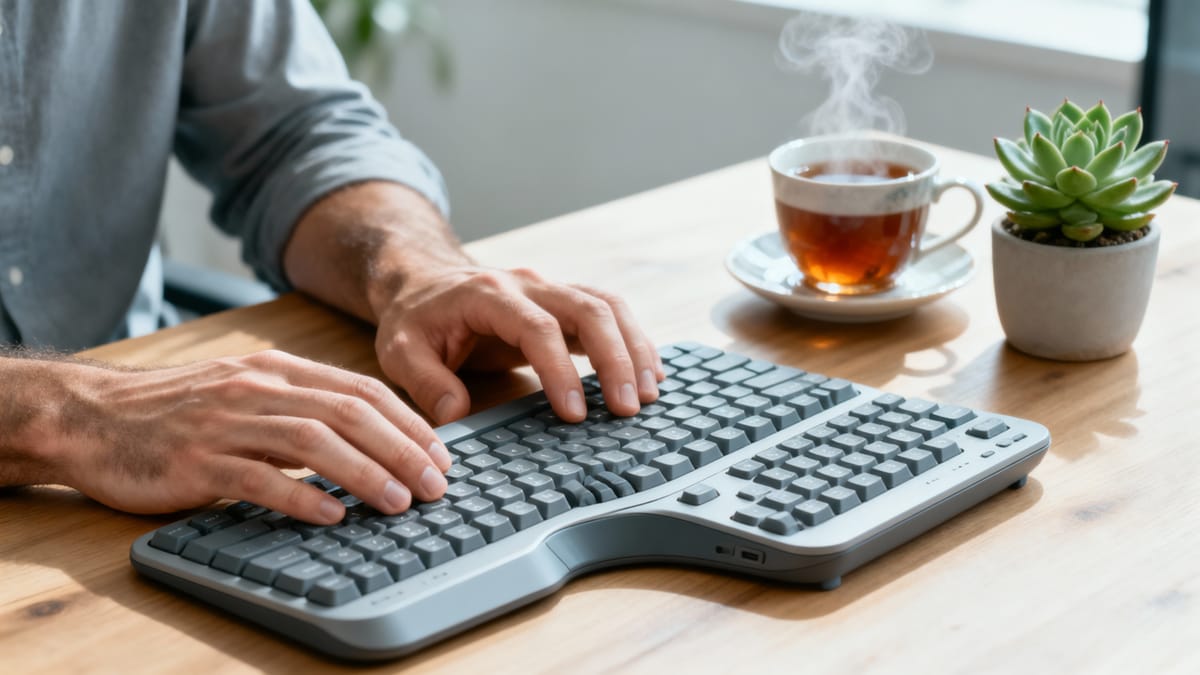
The Standing Desk: A Tool, Not a Trap
Standing desks have surged in popularity, often hailed as the ultimate solution to the modern workday. However, standing rigidly for four hours is just as taxing on your lower body as sitting all day is on your upper body. The true value of a standing desk lies in the transition.
If you use a height-adjustable desk, treat it as a tool for movement rather than a permanent new stance. Try starting your morning on your feet for the first forty-five minutes while you clear out your inbox. When you need to dive into a deep, focused task that requires intense concentration, lower the desk and sit. Alternate between the two. When you do stand, keep a soft, micro-bend in your knees, and consider keeping a small footrest nearby so you can alternate resting one foot on it, which naturally shifts your weight and keeps your lower body engaged.
The Micro-Movement Strategy
Even with the best ergonomic setup in the world, your body still craves movement. Integrating micro-movements into your routine ensures that your joints stay lubricated and your muscles stay warm. You do not need to roll out a yoga mat in the middle of a conference call; you just need a few simple, subtle habits to break up the physical monotony.
- The Horizon Stare: Every twenty minutes, look away from your screen and focus on an object at least twenty feet away for twenty seconds. This allows the small muscles in your eyes to relax, which in turn reduces the subconscious tendency to lean your head forward toward the monitor.
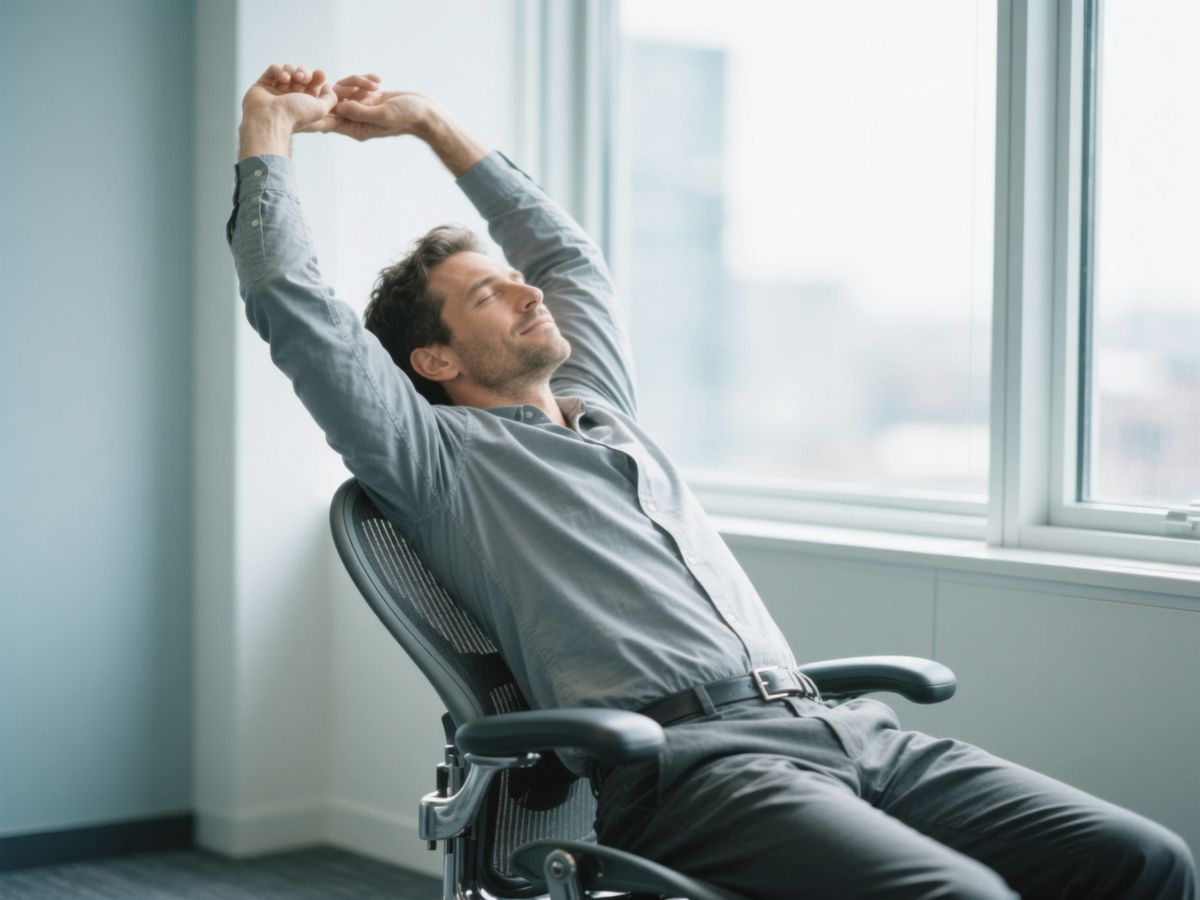
- The Seated Twist: Plant your feet firmly on the floor. Gently place your right hand on your left knee, and reach your left arm toward the back of your chair. Rotate your torso smoothly, breathing deeply into the twist. Hold for a moment, then switch sides. This keeps your mid-spine mobile and comfortable.
- The Chest Expansion: Interlace your fingers behind your back and gently press your knuckles toward the floor while lifting your chest toward the ceiling. Take three deep breaths. This counteracts the forward-folding motion of typing and opens up your breathing capacity.
- The Ankle Activation: While reading a long document, simply extend your legs under your desk and slowly roll your ankles in wide circles, first clockwise, then counter-clockwise. It encourages circulation and keeps your lower legs feeling light.
Environmental Cues That Keep You Loose
Your posture is not just a product of your furniture; it is heavily influenced by your broader environment. Lighting, for example, plays a surprisingly large role in how you hold your body. If your workspace is too dim, or if you are fighting the glare of a window behind your monitor, you will naturally squint and lean forward to see the screen more clearly. Position your desk perpendicular to windows to utilize natural light without the glare, and ensure your room is bright enough that your eyes do not have to strain.
Hydration is another excellent, covert mobility tool. Instead of keeping a massive jug of water at your desk, keep a smaller glass. This forces you to stand up, walk to the kitchen, and refill it every hour or two. That brief walk is exactly the kind of unstructured movement your body needs to reset its mechanical alignment.
Sustaining the Momentum
Redefining your home office is an ongoing process of tuning and tweaking. The goal is to create an environment that feels like a supportive partner in your daily routine, rather than an obstacle you have to endure. When your chair supports your pelvis, your desk welcomes your arms, and your monitor meets your gaze, you remove the physical friction from your workday.
By prioritizing dynamic movement and establishing a workspace that honors your body's natural mechanics, you protect your endurance. You ensure that when the laptop finally closes for the day, you have the vitality and physical comfort to step away from the desk and fully engage with the rest of your life.
A supportive external environment is only half the equation for sustaining your daily vitality. To truly thrive through long stretches of focus and keep your body feeling its best, you need to support your physical foundation from the inside out. Discover how our daily wellness routine can help maintain your joint comfort, support everyday mobility, and keep your energy steady from your first morning meeting to your evening wind-down.